


I know, I know, we are all waiting for Thursday and the publication of Robert Harris’ Agrippa. But more than a year ago, I wrote this short story, and I thought it might entertain you a little as you wait. It was originally published in the anthology Historical Heroes, from Aspects of History .
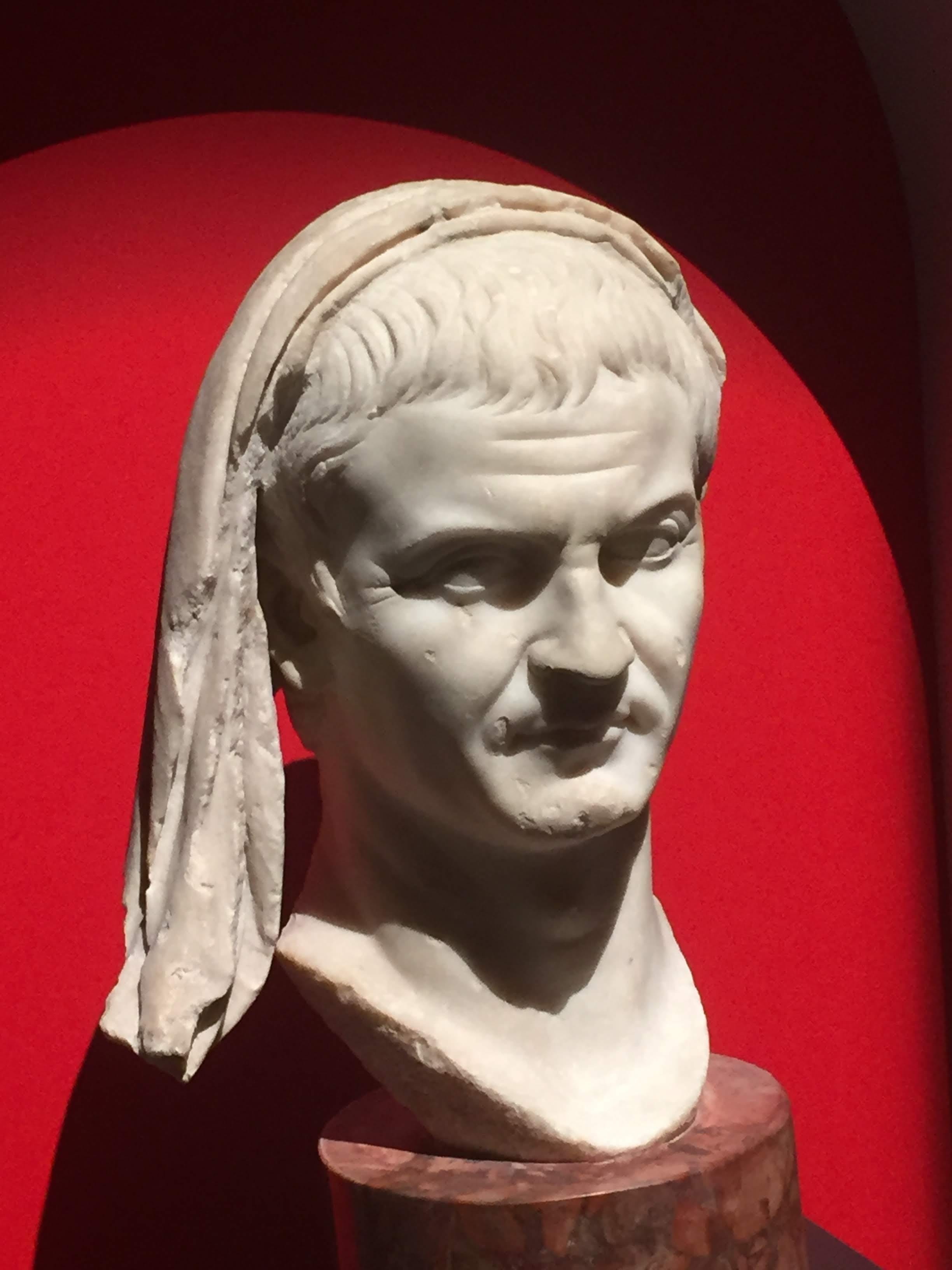
AGRIPPA
“A flag? They gave you a flag?”
“Yes, but it wasn’t just a flag…” The patient levered himself up on his pillows and several people started forward in alarm. Sure enough, the coughing started, and the doctor scurried over and administered some of the liquid placed on the table.
“Now try not to move until you are completely comfortable, sir.”
“I’m moving because I am not comfortable,” the patient growled in between sips. He gave one last cough, then sank back. “I want to be able to talk properly and I can’t at this angle.”
“We shall see what can be done,” and the doctor summoned forward his two slaves, who gently lifted the patient and inserted several cushions behind him before settling him back. The doctor looked thoughtfully at his patient, who glared back, and then it seemed everything was all right. The slaves glided backwards to stand at the wall, and the patient asked gruffly for some decent wine rather than the swill he was currently imbibing.
“I’d rather we waited until evening,” said the doctor and to head off the objections said swiftly, “Now tell me – what is so good about being given a flag? You had won a crucial battle, after all. Surely you deserved at least a triumphal procession through the city?”
The patient fell for it, took a deep breath and said, “First, you aren’t a military man and don’t know what you are talking about. Second, only I can fly that flag, me, and me alone. Every ship I ride in flies that flag and it tells everyone that I am Marcus Agrippa. It means a lot to me.”
“You’ve certainly gained many victories for Rome,” said the doctor diplomatically. He wanted the patient to rest soon, so he was brewing a tea of valerian, honey and hyssop on his brazier. He beckoned to one of the slaves.
“Nicomedes, keep stirring this and don’t let it boil too fiercely.”
“Is that one of your disgusting teas?”
The doctor made a mental note to add some of the soporific syrup he had made up from poppies.
“None of my teas are disgusting, sir,” he said in his best doctor’s voice, the one that practically healed patients on its own, it was so positive. “You will like this one. You have a sweet tooth I have noticed and will enjoy the honey I have added.”
“You make me sound like a child, to be bribed with the promise of cake and honey.” The patient was clearly unimpressed.
“Marcus Vipsanius Agrippa, you are one of the great men of our age and I am honoured to be looking after you,” the doctor said, knowing from the experience of just over a day treating his newest patient that flattery would not work. “Now if you don’t mind…”
“Agrippa. Just call me Agrippa,” said the gruff voice. “Never did like Vipsanius.”
The doctor began the intrusive business of assessing his patient.
“Always squeezing and pinching, you medical men.” Marcus Agrippa was not yet used to him. “Although the others got their slaves to do the prodding.”
“Sir, you are a practical man,” said the doctor. “I have heard that you are not one to stand and shout orders. You get involved, yes?”
“Well, yes.” The patient stopped to wheeze but nodded in appreciation of the point.
The slave tipped some of the tea into a cup, added honey and cold water and stirred carefully. The doctor wiped his hands and spooned the tea into his patient in between each careful breath.
“I heard a story that you even sailed the sewers of Rome yourself when you were a young man, to make sure you saw what your builders saw, to see for yourself the state of our water supply. You, of all people, are what I might term ‘a hands-on man’. Well, so am I. And you still have a fever.”
“You heard about that, the sewers?” Marcus Agrippa sounded pleased. His voice was a little stronger, the breathing slightly less laboured. “Here, give me the cup. I can hold it and drink it myself.”
“Of course I know about the sewers. And the aqueducts. Clean water is vital to human health, we have known that since Hippocrates.” The doctor was now making notes, but he could talk and write at the same time. “You repaired the Marcian aqueduct and built several more. Let me see – the Aqua Marcia, yes, then the Aqua Julia, the Aqua Appia and the Aqua Vetus and one more…”
“The Aqua Virgo.” Marcus Agrippa smiled. “Do you know the story behind that?”
“Story? No, I don’t think so,” the doctor lied. He put aside his pen and smiled at his patient. “Tell me. Or at least – tell me when you have finished the tea.”
“My buildings on the Campus Martius were proving popular,” began Agrippa, a gleam in his eye as he launched into the often-told tale. He sipped at the tea, grimaced and went on. “I wanted to make sure there was a good supply of water. I had plans to expand the Baths. So I sent my engineers off into the hills and we spent several days looking for a fresh spring, a new supply. And on the third day, a young girl approached a group of them and asked what they were doing. Most of them told her to go away, but one engineer realised she might know something, being local. And before they knew it, she had led them to a spring that none of them knew about. So we named the aqueduct after her, the Aqua Virgo. And you know the strange thing? She disappeared as soon as she had shown them the spring.”
“Not so much a girl as a water nymph?” The doctor removed the cup and saw the patient had drunk it all. He passed the cup to the slave and asked for a refill.
“Put some wine in it this time, why don’t you?” Agrippa sounded a little plaintive.
“Maybe later,” said the doctor.
“I don’t think she was a nymph,” said Agrippa. “But I believe the gods were working through her. Mars and Neptune in particular have always been good to me.”
The doctor nodded and felt his patient’s forehead.
“What have you eaten today and have you opened your bowels?”
The conversation grew intimate.
#
The next morning at dawn, the doctor was awakened by his slave informing him that Marcus Agrippa was being violently sick.
The doctor shook his head, pulled on a clean tunic, and took a few moments to pray and burn some incense to the little statue of Aesculapius on a stone altar in the corner.
He found his patient looking exhausted and with the grey tinge to his skin that the doctor knew well.
“Let’s have a look at you,” he said, his voice carefully not-too-cheerful. His patient saw right through that.
“You don’t need to coat everything with honey, like your teas,” said Marcus Agrippa in a voice little more than a whisper.
“You’d be amazed at how useful honey is,” the doctor said, examining his patient with concern. Agrippa’s eyes were tinged with yellow, and the breathing sounded as though it bubbled up through soup.
“The army doctors used to smear honey on bandages.” Agrippa sounded interested, as though they were holding a normal conversation.
“Quite right. Which campaign was that on?”
“I first noticed it in the hospital tents after Philippi,” said Agrippa. He breathed deliberately and lay back on his pillows; the doctor felt his patient relax.
Keen to keep him distracted, the doctor asked Agrippa which campaign stood out in his mind. “The one that you feel went as you had planned, with the best outcome.”
“Not Philippi, certainly,” said Agrippa. “I was too young to know what was going on and Augustus – the Princeps – was ill. We were all terrified he would die. And not Actium, as most people think. I just stood on a ship’s deck for that battle.”
“And you are carefully ignoring the months of harrying Antony’s ships and the way you gradually pinned him down in the Gulf of Ambracia,” said the doctor. He noted with professional satisfaction that his patient’s face showed a little colour. Was the great Agrippa blushing?
Agrippa laughed without thinking and set off a bout of coughing. There was a flurry of activity as slaves brought water. The ubiquitous honey was spooned down Agrippa’s throat and the doctor even allowed him a little wine when he was once more sitting back against his pillows and breathing evenly.
“You know all about me,” he said.
“You are the Princeps’ right-hand man, the most important soldier and general in the Empire,” said the doctor. “Everyone knows about you. Your acts of generosity and heroism, if I may say so, are innumerable.”
And you don’t deserve to die like this, he added to himself. Carefully, he mixed poppy syrup and a touch of henbane into wine. He could at least give Agrippa a peaceful end.
Once Agrippa had slid into a doze, the steward came in to supervise the tidying of the room. Slaves topped up the jugs of wine and water and cleared away the used bowls, the cloths and towels. One stayed to mop the floor. The doctor approved of the attention to cleanliness and said so.
“It’s a crime, what is happening to him,” said the steward. “When you think of what he has done with his life. The battles – actually, never mind battles, the campaigns he has led! More or less conquered Spain single-handed, got Gaul and the Germans under control, always off in the East sorting out things there. They rate him, in the East you know, that King Herod sent a messenger only a few days ago, asking how he was.”
The doctor nodded. One thing that weighed him down as he ministered to Agrippa was that the Empire was losing such a man.
“He is irreplaceable,” he murmured.
A quick glance at the steward and the doctor saw tears on the man’s cheeks. After a moment’s hesitation, the doctor put a kind hand on the man’s arm.
“He won’t suffer.” It sounded like a vow.
“I’d do anything to help him,” the steward said. “We all would.”
The doctor did not know what to say, so he changed the subject.
“The Princeps has been notified?”
“Yes. I expect him soon, maybe even tomorrow.”
“I hope he hurries. It won’t be long,” the doctor murmured. “May I trouble you for a large bowl of water, freshly boiled? When he wakes up, he will no doubt demand a bath and a shave, and I see no harm in it as long as he keeps warm and lets the slaves do all the work.”
#
Forerunners had arrived early in the morning, so the doctor made sure that he was ready and waiting. The procession made its way up the long drive from the road, a few riders, a handful of guards and two carriages. Augustus never liked a fuss.
The leading carriage rolled to a halt, and the steward hurried forward with steps. The doctor, used to the efficient way in which Agrippa’s household operated, appreciated their effort even more: he had just broken the news to them and knew that the steward was not the only one to have been in tears a few moments ago. He made sure that his expression was appropriately sombre as he watched the Princeps clamber out. How would Agrippa’s greatest friend take this?
Augustus saw the faces, and he bowed his head for a moment, then turned to address someone in the carriage.
“Now careful of that step there, we can’t have you slipping in your condition.”
“I am always careful, Father,” came the reply as Julia bent to place her foot on the first step. She reached the ground before she looked up to see the doctor and immediately understood. She held his gaze for one long moment, then busied herself shaking out her shawl and re-wrapping it with the help of a maid who hurried up from the carriage behind. The doctor saw the roundness of her belly clearly as the fabrics shifted around her.
The steward now came to stand with the doctor, and Augustus led his daughter forward. Even the birds seemed to stop their singing as they waited for the Princeps to speak.
“No need, gentlemen, I see it on your faces. My poor friend. When did it happen?”
“An hour ago, in his sleep, Princeps. A peaceful end.” The doctor kept his voice low and soft. “I am very sorry for your loss. And you, my lady Julia. But may I suggest that you come in and rest? The shock…”
“Of course,” and Augustus turned to fuss over his daughter, leading her into the villa and letting her maid take her off to her quarters with a stream of advice following her.
The rituals of death now began. The doctor’s slaves were already preparing the body, and the villa’s staff set up a table in the hall. On the estate, they would gather wood for the funeral pyre and cut cypress branches to pin at the villa’s door. The widow would go into mourning, and Augustus would grieve for the best friend a man could have.
Julia’s maid helped her undress and change into a comfortable loose tunic, then unpinned her hair, gently brushing each tress as it came down. Julia sat and stroked her belly, thinking of the relief of knowing that this would be the last child she would have to bear for Rome. One more repulsive act of childbirth, then the baby would be handed over to the nursery on the Palatine and her father would decree what would happen to it, just as he had with all her children. But she would be free, at last.
She gave a sigh and stretched carefully, longing for her bed. It never crossed her mind to visit her husband for one last time. She had spent the last ten years with a man of unparalleled virtue, who made hard work his idol, and paid the gods their due. He had been a courteous husband, though he had insisted that she accompany him on his journeying throughout the Empire.
“Almost,” thought Julia, “as though he didn’t trust me!”
To be fair, they had both enjoyed the travel. Together they had been to Athens, Ephesus and Sappho’s island of Lesbos. She had travelled more with him than she would ever have been allowed by her father. But in the end, Marcus Vipsanius Agrippa had not been her choice. He had never belonged to her; he had always been her father’s man – or rather, he had belonged to Rome, like one of the heroes of old, content to serve and careless of power.
Julia fell asleep hoping that her next husband would not be such a fool.
A wonderful story. One feels this could be just how it happened. And such a delicate sting at the end: poor Julia, little did she know . . . .
Get Agrippa ….please!!