

Time, time, time…
Calendars, weeks and hours - oh my!

Last week, fellow histfic author, Kate Sheehan-Finn posted this on Threads. She showed a Roman mosaic from c. 150 CE that depicted seven deities, Sol, Luna, Mars, Mercury, Jupiter, Venus and Saturn, the deities that represented a seven day week.
We know when the seven day week became officially instituted - 321 CE when the Emperor Constantine, newly converted to Christianity, imposed it on the whole Empire. To what extent people knew/used a seven day week before then, is quite tricky to establish. I have a vested interest in this, I have to confess - throughout my first book, Rome’s End I used “week”. I was so busy calculating journey distances and what people wore and ate that I never thought about units of time. But in 45 BCE, when Rome’s End was set, I’m pretty sure the Roman state did not have weeks as such, because early Roman calendars revolved around market-days which fell every eighth day.


A seven day “week” had been around in parts of the world for hundreds of years of course - and according to Genesis, even God used it at the beginning of time, creating the Earth in six days and resting on the seventh day. The mosaic in Kate’s post indicates that a seven day cycle may have been known in Roman Spain in the second century CE, which surprised me (though it shouldn’t. Plenty of Romans were also Jewish, for example).
Issues of timing and calendar affect other eras: in 1752 Britain changed from a Julian calendar to the Gregorian calendar that had been used in Europe since the sixteenth century. But if a traveller sailed from Britain to France on April 1st in 1750, and the journey took a day, they would land in France on April 13th. When the change to the new calendar happened, Wednesday 2nd September 1752 was immediately followed by Thursday 14th September - and there were riots as people demanded their lost eleven days back…
So what is a histfic writer to do? Yes, we must aim for accuracy. But we also have to make sure that readers don’t get bogged down in unfamiliarity. I once tried dating chapters according to the Roman calendar and it required a long and tortuous Author’s Note. I’ve also used the regular Roman festivals and felt more comfortable with this. It reminds me and the reader of the way festivals are woven into the rhythm of the year in Rome. I have also seen Saints’ days used in other historical fiction, though I cannot remember the book or the author now - anyone able to help?
As an interesting aside - in the school where I worked, we had a seven day cycle. If Monday 1st March was Day One then the next Day One would be Wednesday March 10th. This ensured that no subject got stuck with the dreaded “last thing on a Friday” every week, and students and staff seemed to adjust pretty easily, though a special school diary for everyone was essential. There was the occasional, “I’m sorry, Miss, I packed for Day Two instead of Day Three”. But it was never an issue.
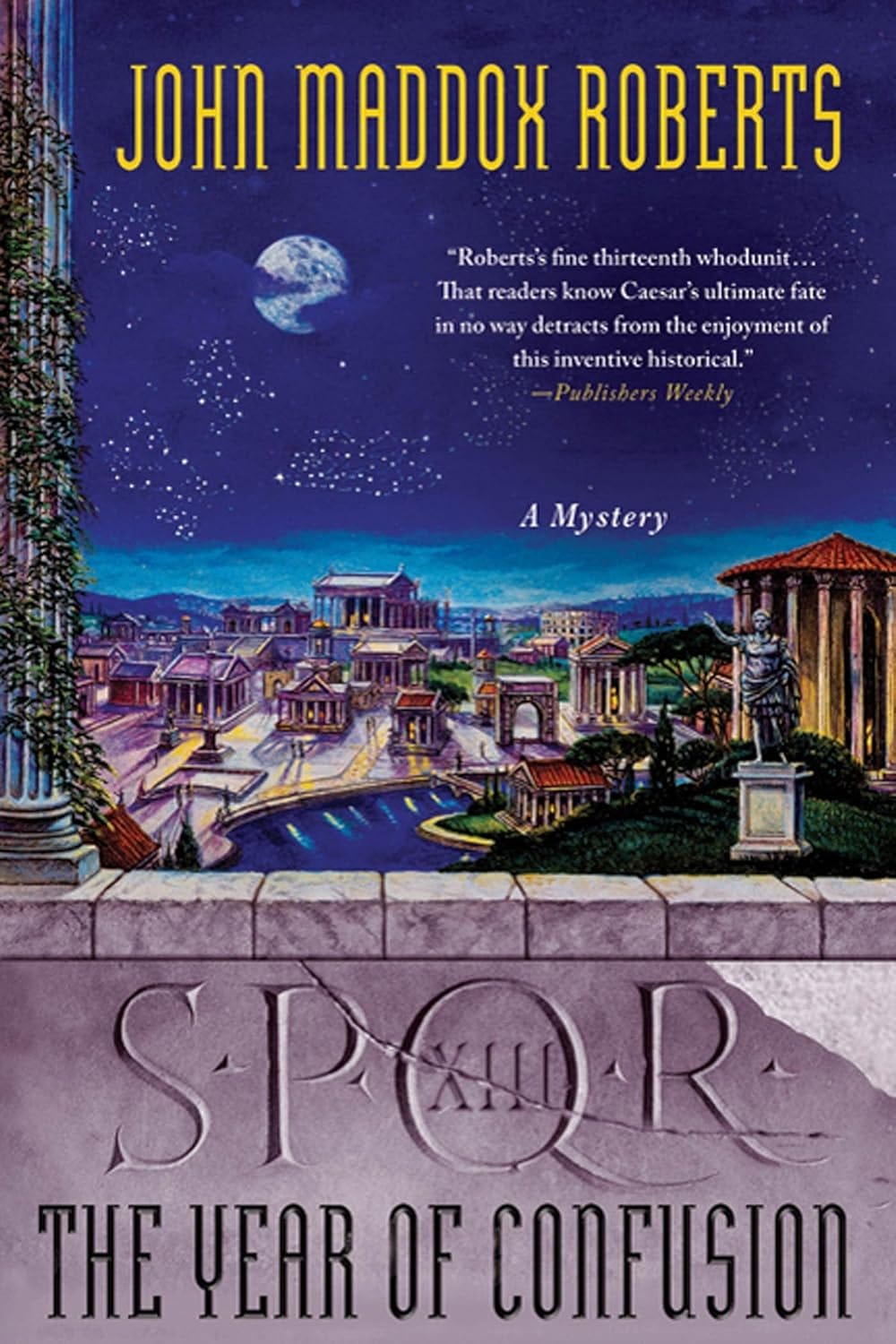
My favourite book when it comes to dealing with such things is The Year of Confusion by John Maddox Roberts. The last in Roberts’ excellent SPQR series of Roman murder mysteries, this is set in the notorious year in which Julius Caesar reformed the calendar using top mathematicians and astronomers. The year 46 BCE had to be lengthened to 445 days so that future years would at last have months conforming with seasons. Roberts does a remarkable job, not only explaining the reforms but incorporating them into his plot. He even starts his book with the hapless senator Decius Caecilius Metellus attempting to explain the reforms to a crowd in the Forum — barely making it out alive.
I have made myself a list of terms I can and cannot use for books set between 45 BCE and 15 CE:
Hours, days, months, festivals, seasons, dawn, dusk, midday - all okay
Weeks, seconds, minutes, Sunday, Monday, etc - not okay
Please add or amend as necessary! And for a little quiz - why is September the ninth month of the year, when septem is the Latin for seven?
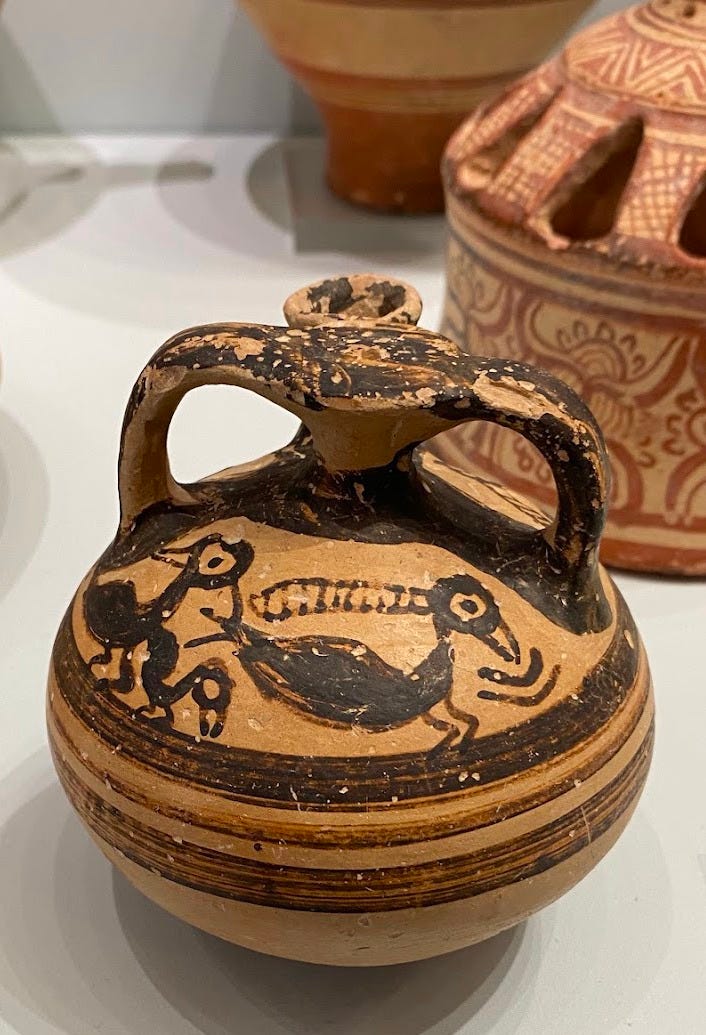
The photographs in this Substack are mine, from the archaeological site of Ephesus, Heraklion Archaeological Museum and the National Archaeological Museum of Athens.
With thanks to Kate Sheehan-Finn.
Same problem here, Fiona: What to do when plotting requires a label for a timespan that's more than a day but less than a month? The period between market days is too useful to ignore. I figure that if Romans said, "Caesar was stabbed during the last nundinum," poetic license allows me to write it as "Caesar was stabbed last week." That seems to be a lesser evil than bringing readers to a screeching halt.
My high school ran on odd and even days, which only needed to be adjusted once or twice a year around holidays. It was clearly indicated which was which in the daily newsletter that came out before we got there, along with any other scheduled items like sports, arts, and the day's lunch menu. With illustrations including the masthead by some very talented cartoon artists.
The even days had stately balanced fonts for the masthead; the odd ones had letters of all the non-balanced type that teens could draw, so you didn't even need to read to know which day it was.
I clearly remember at least once when the menu was illustrated by a cartoon drawing of a tray of gloppy objects, and the obligatory carton of milk was labeled "MOO JUICE".